“Let’s play,” says Victoria Coren, and then adds, as airily if she were talking of pence rather than pounds, “for a hundred? Or two?”
There’s ten of us round the oval table at the Vic, a cavernous space above an Edgware Road casino which is London’s most famous card room and Coren’s second home. Apart from me, all feature in her long-awaited memoir, For Richer, For Poorer: A Love Affair With Poker. There’s Alan the sex mogul, who’s bald, smokes a cigar and drives a Bentley; Neil “Bad Beat” Channing, one of Britain’s more famous players; and “DY”, who’s still complaining that Coren writes that he has a lisp.
“You’re very masculine and I love you very much,” Coren finally tells DY, “but you do have a lisp. And I have a squint and a big nose.”
She doesn’t really. With her long blonde hair and ready smile, she’s in her element: a joke here, a raise there, a sympathetic squeeze of the shoulder when she takes someone’s chips. She casts herself in the book as Alice in a looking-glass world, the poker games as a mad hatter’s tea party.
Coren was drawn to poker as a teenager, when her brother Giles (also a writer and columnist) started holding games. “I wanted to spend time with boys because they seemed endlessly fascinating and mysterious. I soon discovered boys were easy to understand; it was poker that was fascinating and mysterious.”
The first few times she tried to play at the Vic were, she says, like the bit in American Werewolf in London where all conversation stops and “60 eyes all swivel towards you”. She literally ran away. “I thought, they’re all male, all cockneys, all between 40 and 70; how can I, a middle-class girl, fit in? Then I realised it could never be scarier than walking into the school canteen. Each and every one of these players feels like a misfit, and that’s what we have in common.”
Frequently Coren was the only woman in the room, let alone at the table. But eventually she came to speak the arcane language of wire-ups, trips and suited connectors, to measure out her money in ponies, carpets, bottles and monkeys. “The Vic’s like the Tube,” says Coren. “We’re not immediately friendly to people we don’t know. But the plus side is, when you do finally get on, you know they mean it. I feel very patriotic – not as a Briton, but as a Londoner.”
She’s since played with millionaires and gangsters; at private games guarded by machine gun; with literary figures such as Martin Amis and Al Alvarez. She’s helped poker join the 21st century, as a TV presenter on Late Night Poker. And she’s seen the internet change the game from a refuge for misfits to a career choice for maths grads. It’s now a heavily sponsored billion-dollar business. Starting this Thursday in London’s Casino at the Empire, the third World Series of Poker Europe presented by Betfair will make two millionaires: one a humble chancer who’s qualified for the Free Million Dollar Game through the Betfair internet site, the other a bona fide world champion.
The WSOPE may bring the world’s very best players to Leicester Square, but Coren has as good a chance as any. In 2006 she won the European Poker Tour and £500,000 – the biggest single win by a British woman. But she’s also very upfront about the game’s terrible compulsion, the players, less skilled or disciplined, who’ve lost everything.
“I have a weakness for gambling,” she admits. “Don’t ask me how much I’ve lost on Blackjack. Luckily I roped it into poker, where you can overcome fate with judgement and caution and discipline, while still feeling the adrenaline thrill of risk.”
Her entire social life now revolves around the game. Does she play poker because she’s not married with kids? Or is she not married with kids because she plays poker? She sighs. “That’s the question I set out in the book to ask, if not to answer. All I can say is, I only gamble on certain hands, under certain limits. Committing to marry someone and have a child… that’s like gambling with your whole life.”
Back at the big game, my suited Ace-Jack (“Ajax”) comes up against Ace-Queen (“big chick”) and a pair of Kings (“pocket cowboys”). I’m knocked out. “That’s poker,” says Coren. “It’s ugly.”
I join one of the dozens of cash games that are always running at the Vic, lose a little more. Then Coren, having won, invites me to a second £100 game. This would leave me with exactly £1 to my name. Do I dare? Two hours later, I stand up victorious, with £200 profit on the night. Coren seems genuinely delighted for me. Because that, as she knows better than anyone, is poker too.
For Richer, For Poorer is published by Canongate, £16.99. The WSOPE runs Sep 17-Oct 1 at the Casino at the Empire, Leicester Square. www.wsope.betfair.com.
“Brando was wonderful. All he did was f*** about all day and tell jokes” (Times, 2010)
When The Singing Detective came out, I was transfixed. It was, and I suspect still is, quite simply the best and most original TV drama ever produced, and Michael Gambon was brilliant in it. So it was a huge pleasure to meet him Dublin, where he talked about acting, religion, fathering kids in his late ‘60s, and nearly dying, twice. And I don’t mean on stage.
Sir Michael Gambon, or “The Great Gambon” as Ralph Richardson used to call him, wears his greatness lightly, like the rumpled overcoat he sports in Dennis Potter’s peerless TV drama The Singing Detective. “I’ve got a terrible cold,” he apologises as we meet in Dublin’s historic Gate Theatre, and blows into a tissue by way of illustration. “Had to cancel our rehearsals today.”
It doesn’t slow him down long. Painfully shy by nature, which he reckons is why he became an actor, he nevertheless wears white and pink striped socks under his sober suit. And if it takes half an hour or so to gain his confidence, that famously sonorous voice is soon in full flow.
He loves to tell how, when he auditioned for Sir Laurence Olivier at the newly formed National Theatre, he dared in his ignorance to recite Richard III, then tore his hand open on a nail before he could begin. He and his fellow spear-carriers were in awe: “We used to know if we walked at a certain time along a certain corridor at the Old Vic, we’d pass him. ‘Evenin’ Sir!’ ‘Hello.’ Then we’d present ourselves at the stage door when he was leaving after Othello and come out after him, past all the people with their autograph books, as though we were his friends.”
He reserved similar adulation for Robert De Niro. A notorious prankster, Gambon used to install a photo of the Hollywood star in his dressing room wherever he performed, signed: “To Mike, best wishes and love forever. Bob.” Gambon, of course, wrote it himself. But four years ago the dream became reality when De Niro directed him in The Good Shepherd.
“I was walking down St Martin’s Lane with Robert de Niro, on a busy Saturday night, and you walk as though you’re his mate, you know. There were a few of us, and he said we were going to Sheekey’s. I said, ‘You won’t get in there without booking.’ Ha ha! To De Niro! He looked at me as though I was mad. Packed Saturday night, he walked in, and suddenly there was a big table, cleared!”
De Niro is just one of “The Three Os” Gambon has worked with: Pacin-o and Brand-o being the other two. “Ooh, Brando was wonderful. All he did was f**k about all day and tell jokes. He pretended one day he didn’t know what ‘Action’ meant. And the First Assistant Director was terrified of him, it was like meeting God! And he said, ‘Um, oh, you have to start acting when I say that.’ And Brando said, loftily, ‘I haven’t acted for about 30 years, and I don’t intend to start now!’ Ha ha haaaah!”
When Gambon spins an anecdote, his surprisingly long and elegant fingers weave the story into a tapestry of air. They are craftsman’s fingers: trained as an engineer, like his father before him, he likes to repair cars and watches, and does intricate engraving and inlay work on the antique guns that he collects at huge expense – that’s where the cheques go from playing Harry Potter’s Dumbledore, or the villain in the forthcoming Christmas episode of Doctor Who. For a particularly choice reminiscence, such as how Top Gear named a section of race track “Gambon’s Corner” after he took it on two wheels, or how Kenneth Macmillan offered him the priest’s role in the Royal Ballet’s Romeo and Juliet (sadly Macmillan died two weeks later, and Gambon’s dream to be the first person in the company with size 13 feet died with him), he’ll leap up and use his whole body.
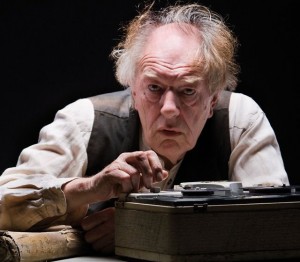
Shorter than you’d expect, Gambon is still an imposing physical presence despite his 69 years. Which, whether by coincidence or design, is exactly the age he is called upon to play in Krapp’s Last Tape, one of Samuel Beckett’s most autobiographical plays which transfers to London’s West End this week.
The script is just eight pages long, the production just under an hour. For the first 20 minutes, Gambon does not speak at all. It’s perhaps the role he was born to play, even if he had to wait 69 years to play it: the perfect combination of silent physicality and vocal mastery, of pathos and black humour.
Krapp, a writer who never achieved the literary success he once hoped for, celebrates his 69th birthday in solitude, as he has for decades, by recording his thoughts on tape. But he also plays back the tapes from previous birthdays, notably his 39th, when he’s forsaken the love of his life for the art that someday, a day that clearly now will never come, could make him immortal.
“I’ve never seen Krapp’s Last Tape,” says Gambon, “not even when Harold [Pinter] recently did it, sadly, so I don’t really know how it’s meant to go! But whatever I’m doing seems to be right. I’m told I do play him more frail, perhaps with more pathos than others. He’s near death, you can tell from the title, and if you’re big and bulky, like me, you don’t walk well. So I stagger around a bit, my hair askew.”
He hunches into himself as he speaks, suddenly looking every one of his 69 years. It’s a painful role for an actor coming to terms with his own mortality. On Boxing Day 2008, Gambon reduced mourners to tears with a reading at his friend Harold Pinter’s funeral. And earlier this year he had to pull out of playing the poet WH Auden in The Habit of Art, a part written specially for his saddlebag face and honeyed voice by Alan Bennett, due to a major medical malfunction.
“I basically had a leak of blood, inside me. You just go… ‘boom’.” His whole body slumps limp and lifeless in his chair. “Then you revive and they put you on a drip, they put microcameras up your bum and down your throat, and you go home, and three days later, ‘bfffff…’ again. They could never find out what it was, and I’m all right now, but it was very annoying.”
That’s something of an understatement, though one typical of Gambon. He’s the same when dredging up his first brush with death, as an eight-year-old growing up in Camden, North London. He was a solitary child, with just one best friend, Kevin, a quiet Asian boy with whom he spent his Saturdays breaking into London Zoo and fishing in the canal. They would take the spokes out of a bicycle wheel, tie a burlap sack to the rim, put half a loaf of bread in the centre, and lower it into the water. The gudgeon fish would feed, you’d slowly raise the sack – Gambon’s nimble fingers mime the scene, rendering his words superfluous – and they would flog the trapped fish as bait.
One day, Gambon reveals almost as an afterthought, he fell in. And in those days, inner-city children never learned to swim. “I just remember looking up through the water at the sky, and seeing all the colours of blue. A man dived in from the bridge – I never saw him again – and dragged me out. I’d certainly be dead otherwise. I don’t remember any fear, I just remember being lifted out into the air, and placed on to the bank. I stayed there till I dried. Then we went to the zoo, went home, and never told anyone.”
It was, without being too fanciful, his first glimpse that there was something beyond the self. Raised Roman Catholic, he became a dedicated altar boy, up for mass at six in the morning, but found it was the spectacle, the ritual, the dressing up that moved him more than religion, and credits that for his move on to the stage aged 19 despite never having even seen a play. He thinks it’s a terrible shame that the Catholics abandoned Latin mass – though he was told off for changing the words from “mea culpa, mea maxima culpa” to “me a cowboy, me a Mexican cowboy” – and would love to be accorded an audience with the Pope on his visit this week. Nearly as much as he would like to meet Curb Your Enthusiasm’s Larry David.
Our allotted time is long up. Gambon has already batted away questions about his late brother and his tangled love life – ten years ago he fell for Philippa Hart, a set designer roughly the same age as his son, though he has only half left his wife – with a curt “I don’t talk about that.”
But the sun crosses his weathered face when asked about the two small sons he’s recently fathered with Hart, aged three and one. “I’ll just say this. I have two little boys, one is called Tom and one is called Will, and I just… love them. I can’t believe it. They make me laugh. I said to Tom the other day, and I’m sorry but this is a bit rude, I said ‘what’s that?’ And he said, ‘That’s a Lego fireman.’ I said ‘What’s his name?’ And he said, ‘F**khead.’ Ha ha ha! ‘F**khead’! This child is three! He’s already picked it up from kids at school. That really makes me laugh. They are life-enhancing, aren’t they? And Tom’s name, when he’s playing a fireman, is Elvis.”
Clearly Tom’s already picked up his dad’s gift for invention. We share a last cigarette outside the theatre, the Great Gambon and me – let the record show, since Gambon says that he would otherwise get into big trouble, that he absolutely did not light up a crafty fag in the Green Room an hour before – and he starts to tell me about how he drove a car up this busy Dublin highway, O’Connell Street, when he was just nine years old…
But the lost photographer breathlessly intervenes, with only five minutes left in which to get his shot. That story will have to wait for another journalist’s tape. Perhaps on Gambon’s 79th birthday.
Krapp’s Last Tape plays twice nightly at the Duchess Theatre, Sep 15-Nov 20, 08444 124659, www.krappslasttape.co.uk
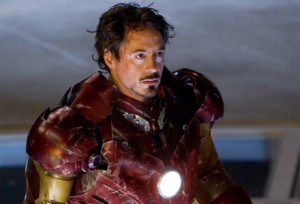
When Iron Man smashed through the half-a-billion-dollar mark last week, Marvel Studios breathed a sigh of relief. Its former CEO had gambled the company on one audacious wager – that if he borrowed $550 million, Marvel could produce its own movies of its own comic-book characters, rather than receiving small royalties from hit franchises such as X-Men and Spiderman. Now Marvel Studios’ first self-made block-buster is the talk of Hollywood, with another one hot on its tail.
The Incredible Hulk, opening on June 13, is less a sequel to Ang Lee’s obtuse and ponderous adaptation of 2003, than the movie everyone wished they had made in the first place. Kevin Feige, the president of Marvel Studios, once said that the new Hulk “would be different – this one will be good”. He’s more diplomatic today: “The first film represented a single visionary’s point of view, and explored a particular sliver of Hulk’s backstory. This one taps into the best of the TV series – Bruce Banner as a lonely man, a fugitive on the run – and also takes the theme from the comics, of tapping into the strength inside yourself.”
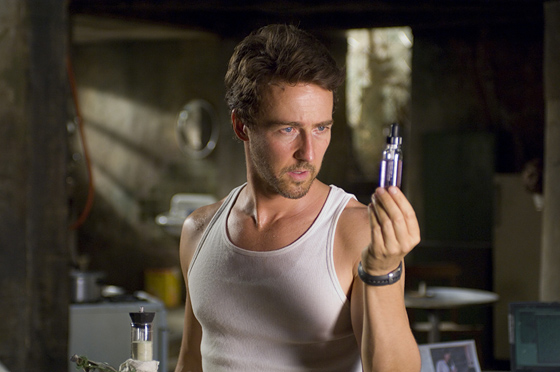
Where art movie maestro Ang Lee baffled special effects crews when he turned up with seaweed and miniature gravel gardens to illustrate how the creature should look, the new director (Louis Leterrier, who directed The Transporter) doesn’t stint on action, pitting the muscle-bound man-monster against an even bigger baddie, with the whole world at stake. And just as Robert Downey Jr added class and credibility to Iron Man, Edward Norton stars as scientist Bruce Banner – the Dr Jekyll to Hulk’s Mr Hyde. That’s some casting coup, given that he turned down the first movie.
Edward Norton as Bruce Banner
It’s all quite a turnaround. For years, Marvel suffered at the hands of financiers who thought capes were something you sailed your yacht around, while rival company DC, publisher of Superman and Batman, ruled the silver screen. But now DC is trailing: 2006’s Superman Returns was a costly disappointment, taking $390 million worldwide, but having cost a hefty $270 million to make.
By contrast, each of the three Spider Man movies took more than twice as much. The truth is that DC now seems old-fashioned. Where DC’s roots lay in the 1930s and the square-jawed championing of Truth, Justice and the American Way, Marvel was the 1960s upstart, the underdog, the rebel, the petulant teen, its heroes more concerned with bills and girls than saving the world.
But why does it matter? Because comics hold a unique place in popular culture. They are at the heart of the American Dream, creating new mythologies for a land too young to have inherited its own. And never have they been more in the Zeitgeist. While terrific films about the Iraq War die at the box office, superhero films flourish.
According to the writer and comics historian David Bishop, “the need for a fantasy of victory is strong.” Or, as Keige puts it, “People like to ask me if superhero movies are a fad. Once you start getting asked that question for eight years in a row, it’s probably not a fad any more.”
Robert Downey as Iron Man
Playground debates have polarised between DC and Marvel for four decades; which you prefer helps define who you are. Put it this way: where DC is Coke, Marvel is Pepsi; where DC is Hillary Clinton, Marvel is Barack Obama; where DC is McDonald’s, Microsoft and the Beatles, Marvel is Burger King, Apple and the Rolling Stones. As the lifelong comics fan Jonathan Ross recently summed it up: “DC books always seemed a little square. Too neat, too tidy, too straitlaced. Marvel was more of the moment: cool and freewheeling in its house style, as editor-in-chief Stan Lee shot the breeze like a hip uncle.”
Out of costume, Marvel’s heroes have problems, feelings, a life. Whereas DC . . . well, take Wonder Woman. Well known character, appeals to men and women, Joss Whedon (Buffy) attached, yet the movie project stalled. Not surprising, says Bishop. “I mean, who is she? What does she do when she’s not being Wonder Woman? DC’s characters were born in simpler times, when it was enough just to be a hero.”
But don’t write DC off just yet. Its most Marvel-like character, Batman, a tortured soul who decided to fight crime after his parents were gunned down in front of him, is back this July in the blackest block-buster so far. Called The Dark Knight, in a deliberate echo of the ground-breaking 1986 graphic novel that was too bleak to film at the time, it stars the late Heath Ledger as a truly psychotic Joker.
There’s more. The other, greater masterpiece from 1986, Alan Moore’s The Watchmen, has finally been shot, and will be released early next year. A pitiless deconstruction of superheroes with an intricate script that moves backwards and forwards in time, it is the Citizen Kane of comic books. That the young director Zack Snyder has taken over from the great Paul Greengrass bodes ill, but then early word is that he’s shot it pretty much scene for scene .
And here’s the irony. Hollywood has long looked down on comics and comic-book writers: I once interviewed the producer of the Judge Dredd film, and he hadn’t even heard of the men who created Dredd, let alone considered them as writers. Not a hit. Not surprising. Ditto The League of Extraordinary Gentlemen, made on a single-line summary of the premise, without recourse to the brilliant comic itself. Big flop. Huge.
But things are changing. Sin City and 300 showed how a scene-for-scene transposition of a comic could work. During preproduction of Iron Man, says Bishop, “Marvel Studios invited in a brains trust of all the people who’d written the comic and, amazingly, treated them with respect.”
Far from Hollywood dumbing down by making movies about comics, as was the assumption in the Eighties and Nineties, it’s actually smartening up. And there are even more superhero flicks coming this summer that are neither DC nor Marvel: Wanted, starring Angelina Jolie and based on a smart and sassy comic by Mark Millar; Hellboy II, Guiller-model Toro’s sequel to the cult original; Hancock, which teeters on parody with Will Smith as a distinctly unheroic superhero; and Superhero Movie, an out-and-out parody by the people who brought you Airplane and the last couple of Scary Movies.
For the future, Marvel has announced two movies for 2010, Iron Man II and Thor, with Captain America and The Avengers to follow in 2011. More intriguingly, Kevin Feige confirms that Ant-Man is go – our beloved Edgar Wright (Shaun of the Dead) is directing and co-writing with Joe Cornish of Adam and Joe. “I just got an e-mail from Edgar this morning,” confirms Keige. “He’d seen Indiana Jones and there’s a great sequence with ants he could see possibilities in. I know Ant-Man is not a major character for Marvel, but we’re doing it because of Edgar, who’s a genius.”
That we’ve got to see. In the meantime, it looks to be, as Marvel’s ever-alliterative Stan Lee would have said, a sizzlin’ superhero summer. Or, as the Hulk would more simply put it: “Hulk smash!”
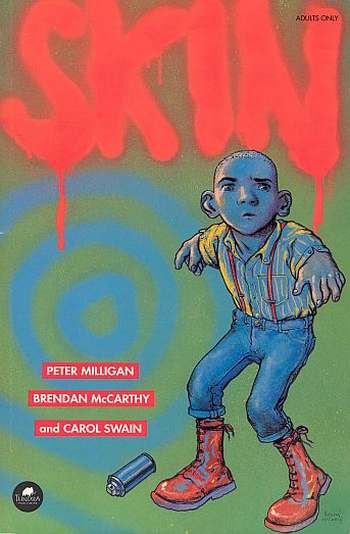
In 1986, Watchmen, Dark Knight and Maus were all published. I was just starting out in journalism. This was to prove my “in”, my special subject that was trendy, timely, and about which I knew more than most. I wrote a number of comics features while at Time Out, before becoming editor, often to do with censorship. This was one: the stirring tale of Martin ’Atchet, thalidomide skinhead.
So we’re all agreed at last: an adult comic is not a contradiction in terms. Novelists Clive Barker and Iain Banks are starting to work with the medium, as is journalist Charles Shaar Murray; more pop stars than not read ‘2000AD’ (Madness named their record label Zarjazz after its catch-phrase, Wendy James wrote a song about one of its characters, Living Colour are seen reading a copy in their new video); other book publishers are following the Penguin lead in going graphic; and after ‘Batman’, new film adaptations are still pouring into production.
This week ‘2000AD’ is relaunching, together with its more political sister comic ‘Crisis’, as the 2000AD Group, complete with a bold new publishing and marketing strategy: royalties on reprints and merchandising — including film rights — will be given to creators, the first time a major British comics publisher has agreed to do so. ‘2000AD’ No 650 now has colour almost throughout and a strong line-up of stories — including a new-look Rogue Trooper, soon to be a major Warner Bros film. Their new range of graphic novel reprints starts this week with the sumptuously drawn Celtic barbarian fable ‘Slaine’. Altogether, the comics world can break out the bubbly and celebrate its bright future as the cutting edge of art in the ’90s. Or at least it could, until somebody sat on the cake.
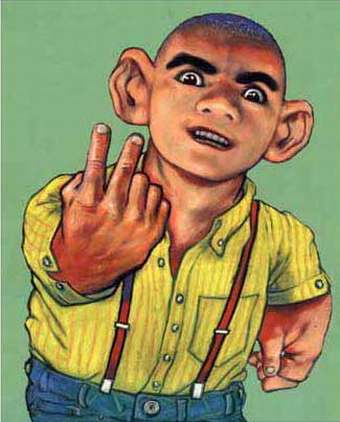
‘Skin’, a new strip that was to run inside ‘Crisis’ and which many considered the standard-bearer for the whole enterprise, was summarily cancelled three weeks before publication. A press release sent out at the time merely states that ‘the market was not yet ready’ for it. But in fact it seems that after their printers refused to print it, the lawyers at Fleetway, the Robert Maxwell-owned publishers of ‘Crisis’, agreed that there might be a danger of prosecution under the Obscene Publications Act as tending to ‘deprave and corrupt’. One can perhaps understand their caution: if Fellini had grown up sniffing glue on a council estate in the ’70s, he might well have created a strip like this. Narrated in a vividly scatological vernacular, ‘Skin’ describes the sexual and intellectual awakening of a teenage thalidomide skinhead, who eventually wreaks a grand-guignol revenge on the drug company responsible for turning him into what his mates call a ‘seal-boy’. Something to offend everyone, in fact; disabled people in particular.
‘I wouldn’t like to offend them,’ counters writer Peter Milligan, who himself was a skin in his teens. ‘I hope that someone reading it would recognise that the thing that offended me, and the thing that really is offensive about it, is the fact that this thing happened, and that they [the German drug company] were allowed to get away with it. So many people just washed their hands of it.’
Ironically, it’s because ‘Skin’ is so well done and has such integrity that it puts people’s backs up. Most political comic strips so far have been worthy manifestos, striking at easy and predictable targets, and at times coming dangerously close to patronising their audience. ‘Skin’s’ moral about greed and lack of accountability in major drugs companies is important, but is never allowed to dominate. This is first and foremost a character study, and of a pretty fucked-up character at that. ‘The reason sex was so prominent,’ says Milligan, ‘was not just for sake of shock, obviously, but because that whole pre-pubescent 14/15/16-year-old thing… all you fucking think about is sex and screwing. At that age — you remember — a few spots and you think “That’s it, I’m never ever going to go to bed with a girl.” And for this guy to have no arms to speak of, you know, this fucking… stigma is going to affect all that stuff. What sort of normal relationship is he going to have? The solicitors at Fleetway didn’t mention it, but I think things like “stink-finger”, references to fingering girls, I think that probably disturbed them. But you know, like, that is what pre-full intercourse is all about. Yeah, but it is a cruel moment when one of the characters says to Martin he’d have to have his face up her arse before he could do that. It’s cruel, but it’s fucking true. And also things like “He looked like a wanker, but he couldn’t even do that.” That’s why sex is very important.
Skin (Milliogan/McCarthy/Swain)
‘At the end of “Skin” it gets less real, goes off into fantasy level, a kind of urban skinhead myth. If there was a sort of skinhead oral storytelling tradition, you know like Beowulf, Homer, that’s what it would be like: “Skin”. The pivotal moment when it changes is one of the moments the Fleetway solicitor objected to. I don’t want to give all the story away, but it involved him going back to this flat with some hippies, and he eats this hash cake and he has a sexual experience, he fucks one of them. And it flips his mind. Things go weird after that.’
Weird is hardly the word; but both this sex scene, when Martin panics and reacts in the only way he knows how — putting the boot in, then scarpering — and the ‘stink-finger’ episode are harrowing and humiliating. That is what gives them the power to disturb, but not, surely, to ‘deprave and corrupt’. If one is going to allocate blame, what of the hundreds of comics in which sex is designed solely to titillate a still largely male young readership, where rape and sexual violence against women are packaged as entertainment, where collectors’ catalogues use the acronym ‘GGA’ — ‘Good Girl Art’ — to describe back issues? Where the cover warning ‘For Adults/Mature Readers Only’ too often signals not something disturbing and challenging, but simply that there is nudity inside? When we are proudly told of the renaissance of ‘adult’ comics, must they all be like the dismal, fellatio-filled ‘Black Kiss’, shrink-wrapped and stacked on the top shelf?
ALLEGORICAL VEGETABLE
But the biggest question must be: if Fleetway’s ‘Crisis’, which boasts of being ‘the cutting edge of British comics’, can’t publish ‘Skin’, who will? It’s a sad indictment of the comics industry that Milligan is currently negotiating with some of the major books publishers, and the prospects there are good. Nor could you imagine them quibbling in the same way as some of the comics publishers who have taken Milligan on. He recalls how DC Comics, America’s biggest, would edit his work during a particularly nervous period: ‘I had to take out all the “shits”, but I could replace them with “crap”. And my characters weren’t allowed to say “Jesus Christ”, but they could say “Oh God” — except for the Irishman, for whom the expletive “Jesus Christ” was considered part of his cultural heritage.’ And a recent cause celebre to rival that of ‘Skin’ was an episode of DCs ‘Swamp Thing’ in which the allegorical vegetable encounters Jesus — that was pulled at the last minute by the publisher.
It’s been a long, hard battle since the ’50s, when the McCarthyite witch-hunts castrated comics and kept them in short pants for the next three decades. Since then, comic shops have been prosecuted; Knockabout comics have been consistently seized at Customs; ‘Action’, which later provided the driving force behind the founding of ‘2000AD’, folded through public pressure in the late 70s. Even magazines have run into difficulty over their support for the medium — several members of The Cuts editorial staff resigned a few months ago over the inclusion of a comic strip, ‘The New Adventures of Adolf Hitler’; and the most recent issue of the trendy arts magazine The Fred was removed last week from the ICA and Royal Academy bookshops, and dropped by its secondary distributor, Central Books, because of a graphic rendering of a rape from Ovid’s ‘Metamorphosis’. Censorship from without and within has been endemic to the comic industry; but somehow, as we approach the ’90s, aficionados may have fondly thought we were beyond all that. The demise of Martin, the thalidomide skinhead, shows that ‘adult’ comics still have a lot of growing up to do.
Next Wednesday, when the Cannes Film Festival rolls out its red carpet for the grand opening film, no actress will flash her megawatt smile. For the first time in its 63-year history, it has chosen to open with . . . a cartoon. Mon dieu! And not just a cartoon, but an American cartoon — in 3-D. Quelle horreur! Has this most intellectual and auteur-orientated festival lost the plot?
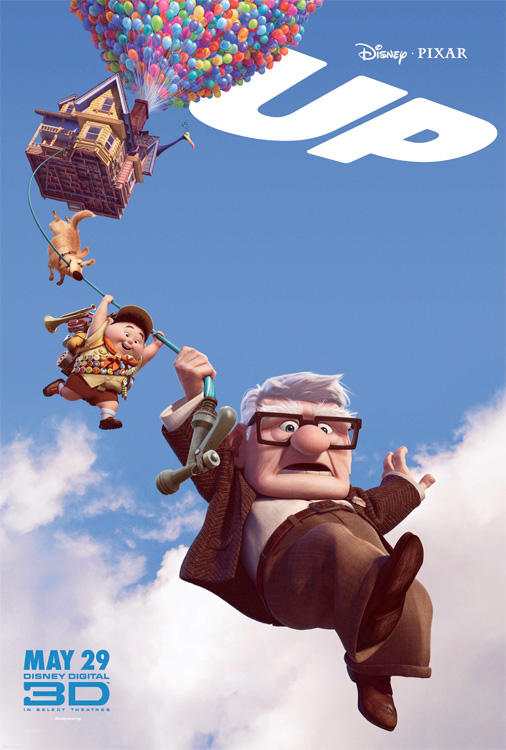
Courage, mes braves, this is the tenth animated film from Pixar, the computer-animation studio that seemingly can do no wrong. Its previous releases, from Toy Story to WALL-E, have grossed nearly $5 billion. Critics love them as much as parents. Up, an unlikely fable about a 78-year-old grouch who fulfils a childhood dream by attaching balloons to his house and floating it to Peru, should be no exception.
Up is a perfect opening film,” says Thierry Frémaux, the festival’s artistic director. “Light, moving, innovative, often funny, a good way to start a festival in a year of world crisis. That it’s an animated film is noteworthy because it’s the first time, but the important thing is that it’s an excellent film in its own right.”
“There is a feeling,” says one French film journalist, “that recently the festival has made some poor artistic decisions for the sake of headlines — The Da Vinci Code? But the French media is very happy with this choice. Pixar films are real auteur films.”
Auteur films? Each Pixar flick now requires about $150 million and years of teamwork from hundreds of people. Can they really be bracketed with Truffaut and Godard? And even if so, what of the Disney deal? Pixar was bought three years ago by Disney for $7.4 billion. Won’t this destroy the magic? Only one way to find out.
To get to Pixar Studios you need either to attach 15,000 balloons to your house or cross the Oakland Bay bridge from San Francisco. To your left, the old island prison of Alcatraz rises from the fog. Beyond it, the Golden Gate. Ahead, the dream factory that is as rare to gain access to as Willie Wonka’s, and just as thrilling.
The front gates still carry a giant Pixar logo — no mention of Disney. A 15ftsculpture of Pixar’s mascot stands guard: it’s Luxo, the white Anglepoise lamp that won an Oscar nomination for Pixar’s first (1986) short, and announced that the cinematic landscape was about to change for ever.
Grinning replicas of Mike and Scully, the stars of Monsters, Inc, welcome visitors inside. Mike is 7ft tall, with big blue eyes and blue fur. Scully is a cyclops: he must be baffled by the 3-D revolution. A tropical waterfall has been built in the centre of the huge atrium, in honour of Up. A little toy house floats overhead, borne this way and that by multicoloured balloons.
You’ve heard stories about working life at Pixar: how it has its own pool, football field and yoga classes; how screenings of rare films are held in its own theatre; how workers in Hawaiian shirts roll from meeting to meeting on scooters. It’s all true, and more: almost everyone you interview in connection with Up has been with Pixar for more than a decade.
“Why would you ever want to move on?” asks Scott Clark, the supervising animator. “I just saw a great film by a bunch of New York students in our screening theatre. Yesterday a group of animators all shaved their heads into mohicans. Kind of a spontaneous group bonding thing, I guess. On Ratatouille there was a moustache-growing contest. It feels here like the old Disney, or like Termite Terrace at Warner Brothers — where all the animators would play jazz together in a band, and Chuck Jones and the guys would play tricks on each other. But though it looks like we’re just playing, it still is work. We’re very serious about making fun things.”
That could be Pixar’s official motto: “serious about fun”. Over two busy days, story-boarders and animators, techno-boffins and gag-writers eagerly lay bare the secrets of Pixar’s toy cupboard. It’s fascinating to see how a rough sketch becomes finished film. A four-second sequence typically takes two weeks to animate, but that’s only after the script has been written (up to three years of development) and the characters designed (another year).
For Up they had to invent a new feather system for a mythical 13ft Peruvian bird called Kevin, and work out how to make 15,000 balloons, each with its own string, interact believably. But more importantly than that, much more importantly, they had to work out how to make the story resonate emotionally with an audience.
The film, finished three weeks ago, is shown in the Pixar screening theatre. When the room goes dark, the ceiling lights resemble stars. With typical attention to detail, some begin to move — shooting stars. Ten minutes in, at the close of a wordless montage of scenes from the old man’s life, you are in tears. For an animated film to carry such a kick is quite extraordinary. Without giving too much away before the Cannes premiere, it absolutely makes you believe the fantastical premise that this pensioner would float his house off to Peru.
Pete Docter and Bob Peterson, who co-wrote and directed the film, are as surprised as anyone at how it’s turned out. The film began as a visual image — a sad old man holding a colourful balloon — and an inchoate yearning to escape society. It took years of brainstorming before the plot emerged, which now includes an eight-year-old stowaway, a dog with a collar that gives hilarious voice to his thoughts, a crazed explorer and his lethal pack of hounds, and that mythical bird named Kevin. More Miyazaki than Disney, it is surreal but believable, hilarious and sweet.
“Animation can capture life,” explains Docter, who resembles a cartoon character himself: two perfectly semicircular ears sprout at right angles from a rectangular head. “But it can be more than life. Like in a restaurant, where you get a reduction sauce: animation can be so pure and concentrated that it speaks louder than life.”
So, after Pixar had spent the past two decades making computer animation more and more realistic, Docter had them chuck it all out and start again. Old man Carl is very stylised and made of squares. His portly young stowaway is essentially a circle. “It’s a film where a house floats into the sky,” Docter says. “You want an animation style that’s simple and poetic.”
Or, as art director Ricky Nierva puts it: “If you want photo-realism, just go make a live-action film. It’s not about being realistic, it’s about making this world believable.”
The result is an artistic triumph, but its commercial success is less assured. However off the wall previous Pixar projects have been, their premise has been easy to market. Toy Story? Yes, on one level it’s a poignant existential meditation on the nature of identity, but it’s also, you know, a story about toys. Monsters, Inc? A company of monsters, generating power from screams. Cars? You guessed it: talking cars. But Up resists the simple sell. “It’s an action-adventure starring a 78-year-old man,” says the producer, Jonas Rivera, when pressed. You can see the problem. You want auteur? This may indeed be the world’s first $150 million art movie. Word of mouth will make or break it.
According to The New York Times, Wall Street has the jitters after one Up-sceptic analyst downgraded Disney shares. Thinkway Toys, a longstanding merchandiser of Pixar spin-offs, is not producing a single item from Up. Does it matter? Consider this: Cars attracted the only poor reviews in Pixar’s history, yet made $5 billion in merchandising. That’s a lot to sacrifice for art.
“We don’t have to worry about all that,” Rivera insists. “John Lasseter [the founder of Pixar] always says, ‘Just make a movie you’d be proud to show your family’. ”
But if Rivera need not worry, Lasseter must. When Disney bought Pixar, Lasseter was appointed creative director over both companies. The stakes are tremendous: with rival studios stuck in a funny-animal groove, it’s not just Disney/Pixar’s future that hangs in the balance, but the soul of animation itself.
“Quality is the best business plan,” booms Lasseter down the phone from his second office at Disney’s animation studio, 400 miles and a whole world away in Los Angeles. “I believe so strongly that if you do it right, our movies last for ever. They continue to do well on DVD, and what I love about Disney is they have so many ways to keep movies alive — theme parks, publishing, the online world, video games.”
He sounds remarkably unruffled for a man who, as one Pixar employee ruefully observed, is now harder to get an audience with than the Pope. Lasseter began as a Disney employee, but the company didn’t share his enthusiasm for computer graphics. (Tim Burton, a contemporary, was also too far-out for Disney’s taste.) Instead Steve Jobs, the recently ousted founder of the computer giant Apple, believed Lasseter was the future, and Pixar was born.
Lasseter’s staff speak with reverence of his managerial style: he favours Hawaiian shirts over ties (he will make a rare exception for Cannes, about which he is “beyond thrilled”), and although he encourages comments and criticism from all, he gives the director enormous creative freedom. The home of Mickey Mouse, meanwhile, became so unpleasant to work in that it was nicknamed “Mauschwitz”. Aside from a brief renaissance in the early 1990s under Jeffrey Katzenberg, before boardroom squabbles led him to set up the rival Dreamworks, Disney was creatively bankrupt.
“I’m so proud to be back,” Lasseter says. “I’ve wanted to work at Disney since I was a kid. But a studio is not the building, it’s the people. The one thing we brought from Pixar is that it’s film-maker-led, not executive-led. Pixar was the only one, and now Disney is the second.”
Lasseter set up sweet and cereal dispensers in Disney’s central atrium to help animators to mingle. More practically, he hired and fired, and introduced a policy of “no mandatory notes” — notes being the soul-destroying changes demanded by any one of a dozen executives, sometimes with little real understanding of the script or desire to do anything other than justify their existence. Disney’s notes, he maintains, at one point nearly derailed Toy Story.
“Even the notes that I give aren’t mandatory,” he insists. “Film-makers in that environment lose their compass, all they’re worried about doing is fulfilling the notes. But these executives, few of them are trained in story or animation or directing. They’re lawyers, or accountants.
“I mean, would you get on a plane and fly to Japan, or would you go to a hospital and get an operation, knowing the doctor was an agent who through politics got control of the hospital? Why would you let these people make creative decisions?”
Lasseter has vision all right, but he has smarts, too. He has stepped up production to one film every year, and will alternate new experiments with dependable sequels. His slate includes Toy Story 3 in summer 2010, Newt in 2011, and after that Cars 2 and a fairytale, The Bear and the Bow. Lasseter has also embraced the 3-D technology that Disney has been developing. He ordered the Up team to go 3-D halfway through production, and has remastered the first two Toy Story films as a 3-D double-feature for October.
There are sound business reasons: 3-D movies can’t be pirated with a camcorder, and it’s a cinema-only flourish that competes with the plasma screen in your home. But animators worry that it’s gimmicky.
“Yes, there are good business reasons,” Lasseter says, “but for me? Yay. I love 3-D.” His wedding photos (he has five children) were in 3-D; so was his 1989 short, Knick Knack. “I couldn’t even watch it for about 16 years because there weren’t cinemas with the equipment.” Thierry Frémaux is another fan: “3-D films are the next adventure. I like to have Cannes always connected with its times, and it’s good to send a sign like that for the opening night.”
So far 1,000 US screens and 100 in the UK have been fitted for 3-D, and 3-D films are busting out all over. The trend works especially well for Pixar. “We pioneered holography and lenticular imagery,” says Lasseter, “and always felt we were building a 3-D environment inside the computer and it was a shame viewers could look at it only in 2-D. But in the end, it’s just another tool. It’s never the technology that entertains the audience, it’s what you do with it.”
In other words, Pixar fans can rest easy. It’s not the Cannes opener that counts, but what’s inside the tin.
The world premiere of Up is at Cannes on May 13. It is released in the UK in October
I was crazy about Batman as a four-year-old, growing up in Canada. Absolutely obsessed. It dominated all my play time. I only wish I still had the bubble-gum cards. So when Batmania swept Britain once again in 1988, I leapt at the chance to meet the original Caped Crusader, Adam West.
HAVING DEVOTED half his life to walking up horizontal walls in leathers and skin-tight nylon and foiling fiendish death traps, Adam West is feeling the pressure. He speaks slowly and softly, his voice just occasionally tinged with that famous steel, lying flat out on his bed in the Mayfair Hilton. Even now the phone never stops ringing. In the few days he has spent in London, his first visit in seven years, he has been besieged with requests for exclusive interviews and had to turn them all down, save television appearances and this one. He is tickled when I describe to him the contents of Time Out. ‘You mean you’re elevating me to the status of The Arts?’
At 58, he now tries to roll with the punches, but there was a time when he tried hard to shake off the role which keeps coming back to haunt him. ‘I made the mistake of allowing myself to be rushed into several movies very quickly when “Batman” folded (after three seasons), because I knew I’d have the typecasting problem, with Batman like an albatross round my neck. There was “The Girl Who Knew Too Much”, which was really awful, then another one, and I said “That’s it, fuck it, I’ve had it.”
‘So I just sat on the beach and licked my wounds for a year; carousing, boozing, anything just to get away. And then I began to realise I’ve given a lot of my life to this, this is what I want to do, I love the process of performing and acting. So I started doing anything I could. I did circuses, dinner theatre, avant-garde theatre … My God, I did “The Happy Hooker Goes to Hollywood”!’
MODEST THOUGH he is, he can’t feign surprise at the virulent outbreak of Batmania when the series was revived, first on ‘Night Network’ and then TV-am — causing ratings to leap by 25 per cent. He knows better than anyone the secret of its success: playing the straight-man with deadly seriousness week after week to anchor a sit-com whose wacky guest stars ranged from Eartha Kitt and Joan Collins to Vincent Price and Liberace. When the first series was broadcast in 1966, he was mobbed by admirers even in small mountain towns; and fame came with a high price-tag. “People would get a little ugly and say “Hey, you’re not so tough, I can take Batman.” I usually try to be reasonable, then turn round and run.’
The current passion for all things ’60s is no hindrance to the new burst of popularity — ‘An Italian paper said, “in the ’60s, it’s the three Bs: Batman, Bond and the Beatles”.’ But the groundwork had already been laid by a peculiarly ’80s phenomenon: the huge sales and hype surrounding Frank Miller’s audacious adult comic book, ‘Return of the Dark Knight’. In it, Batman emerges from retirement grey-haired, embittered, determined to wage war against the increasingly mindless violence on the streets with equal brutality, his youthful sidekick no longer Robin the Boy Wonder, but a feisty feminist.
‘Isn’t that something,’ says Adam West of the book. And indeed he bears some similarity to the Dark Knight: still in good shape, his famous paunch if anything less noticeable, but the years showing in his greying locks, thick glasses, and the trenches in his cheeks. ‘I enjoyed it, its inventiveness, its artistry, a bit nihilistic and violent. If I were to do a Batman movie, I would like to have aspects of that.’
AH, THE Batman movie. Ever since ‘Dark Knight’ appeared in 1986, rumours have been rife of a hard-hitting film that would forever banish the memory of the Camp Crusader. Last spring Dick Giordano, Vice-President of comics publishing giant DC which owns the rights to ‘Batman’, confided it had been scripted, would shortly enter production, and that — snigger — Adam West had applied for the part: anathema to the new, more serious breed of comics fan, particularly when rivals for the role include Mel Gibson.
But, after talking with him, the idea of West updating his role is by no means absurd. It would be entirely in keeping with the idea of ‘Return of the Dark Knight’, and he displays an intelligent, even poetic approach to film-making. When I show him a proof copy of ‘The Killing Joke’, Batman’s latest foray into the ’80s, he is enrapt by the brooding artwork, evidently visualising it as a storyboard. But when his eye alights on a page featuring a graphic shooting, he is suddenly angered.
‘On film this would be Peckinpah, slo-mo “Wild Bunch”. You don’t need to do this — blow people away with huge holes, blood splattering all over the place. But you can (and here his tone becomes conspiratorial) lop off a villain’s head with thin Batwire (chuckles) that snakes out of your utility belt — wssst! — and the head lops off and rolls across a full moon, bloodless.
‘I think in the final scenes of something, if it’s bizarre and mysterious, you can still have Alfred the butler driving the old Batmobile to the rescue. In the picture we’d have been using all hi-tech, wonderful slick new stuff, so you haven’t seen it before, and at the critical moment, there’s Alfred, driving the old Batmobile. People would stand up and cheer, it’s like the cavalry.’
But unlike the Dark Knight, Adam West is powerless to effect his own return, and frustrated at his new enemy: he can hardly sock the face of the corporate power which prevents him from using the character he has made his own. ‘Yes, I care about the character. It’s 20 years of my life, my career. I’ve seen so many people, signed autographs, shaken hands, done television — South America, the Amazon even; anything I can do to keep this thing fresh and alive. I don’t mean to sit here and weep about sacrifice in roles or other directions my career might have taken; I just put a hell of a lot of work into this thing and dammit, I know, better than anyone else, the best opportunities to do a smashing Batman movie. I hate to see the character denigrated, experimented with. Ruined.
‘Integrity,’ he continues, hammering out each syllable with very Batman-like force, ‘is vital, organic to the project! Sometimes I just don’t know. I mean we sit here and talk, and you’ve caught me at a moment when I’m very relaxed… Sometimes I think, I really don’t give a damn. Now, am I tired? Am I losing a little energy, am I getting older? No, I just think I really don’t give a damn because I already did it!
BUT WEST isn’t resting on his laurels. No less than three features are in the can, to be released, in America at least, sometime this year: ‘Doing Time On Planet Earth’, an off-the-wall comedy; ‘Mad About You’, a romantic comedy; and ‘Return Fire’, an action pic.
As for the spirit of ’66, that will be recreated in April in a two-week stage show for charity at the Bloomsbury Theatre, called ‘Batman and Robin: The Last Re-run’. West won’t be appearing, but preliminary glimpses of the script suggest it will be hysterically funny, with the shadow of ‘Dark Knight’ nowhere evident, and walk-on parts suggesting other TV shows of the era like ‘Star Trek’ and ‘Man From UNCLE’. Huge, colourful cardboard cut-outs will supply the full array of Batgadgets, as well as the BIFFs, KA-POWs and ZZWAPs.
And what of Burt Ward, aka Robin? How has he weathered the ‘Dark Knight’ era? During the ’60s he had problems coping with his overnight success, going on about his ‘million-dollar face’. Now, says West, ‘Burt’s a kind of super-businessman. Robin the mogul!’
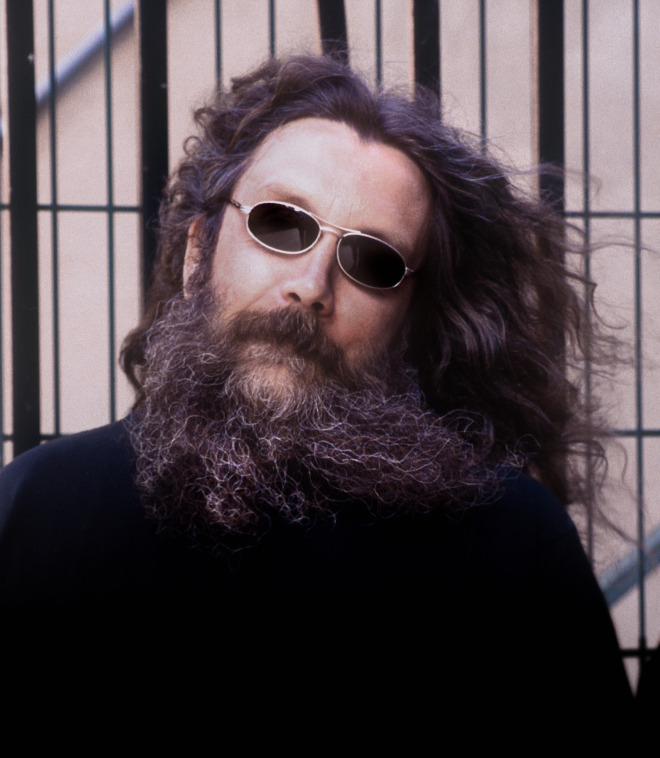
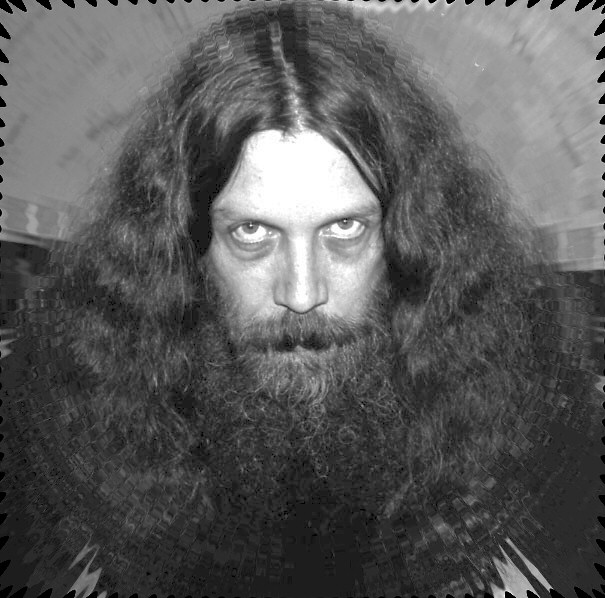
Dominic Wells meets the graphic writer Alan Moore, probably the sanest man ever to worship a snake god
Alan Moore
“I CONTINUALLY monitor the possibility that I might be going mad,” said Alan Moore on publication of his first “proper” novel six years ago, after a decade as the world’s most successful writer of graphic novels.
Reminded of this now, Moore chuckles into his beard: “Oh, I’ve gone much madder in the last six years, though my ideas have become more sophisticated. Yes, I was a mere amateur in lunacy then …”
If an author tells you that he has become a magician (think Aleister Crowley rather than Paul Daniels) and is worshipping a second-century Roman snake God, you do begin to wonder about his state of mind. But no one could question Moore’s success. Seldom straying from his home in Northampton, he works on eight comic titles at once; his Jack the Ripper saga From Hell was turned into a movie starring Johnny Depp; his latest, The League of Extraordinary Gentlemen, is now filming, with Sean Connery heading a £60 million production.
This last began when Moore, who redefined the superhero genre in 1986 with Watchmen, was struck by its 19th century roots: Dr Jekyll/Mr Hyde was clearly the model for The Incredible Hulk, while The Invisible Man could have joined The Fantastic Four. He conceived of a team of heroes in an alternate Victorian universe in which those two fought alongside Alan Quatermain (from King Solomon’s Mines), Captain Nemo (20,000 Leagues Under the Sea) and Mina Harker (Dracula), with the film version adding a grown-up Tom Sawyer for American audiences. “There was a point in the first issue when I had just had Zola’s Nana murdered by Stevenson’s Hyde on Poe’s Rue Morgue when I realised just how much fun it could be pulling down the picket fences between various fictional realities.”
So ripping a yarn indeed, that a producer sold it to 20th Century Fox on the premise alone, before a word had been written. Moore’s black humour is unlikely to survive the transition to celluloid, so do not expect to see Connery playing Quatermain as an ineffectual junkie, nor the Invisible Man living it up as the “Holy Spirit” to a dormitory full of miraculously pregnant young girls. And as always with Moore, there are layers within layers to which a film cannot begin to do justice.
While the question “where do your ideas come from?” gets short shrift from most authors, to Moore it is “the only question worth asking.” Six years ago he was toying with the notion of “Idea Space”, a literal pool of shared concepts into which a correctly attuned artist could dip. Now he is beginning to map it.
“This planet has a physical geography with which we have already familiarised ourselves. But since the dawn of the first stories, there is a fictional geography, where the gods and demons live. We have created this big imaginary planet that is a counterpart to our own; and in some cases these places are more familiar to us than the real ones.”
Moore is intrigued by the notion that stories, and past events, can leave a physical trace. His insanely ambitious 1996 novel, Voice of the Fire, was contained geographically within a ten-mile radius of Northampton, with each chapter set in a different century, from Stone Age to present, and each written in a style suited to the time. It so happened that the final chapter featured a dog trotting about with a decapitated head in its jaws; eerily, soon after he wrote that passage, this actually occurred near by. At the time he wondered whether he had intuited the future event, or somehow willed it into existence (coincidence does not seem an option). What does he believe now? “Probably both. Ultimately I couldn’t say. I don’t think time is as we see it, and that means cause and effect are different from the way we see it.”
Moore can discourse at length on the convergence of modern scientific beliefs and ancient intuitions. In the end, he believes, magic is simply the creation of something out of nothing: be it rabbits from a hat, a plot idea from a blank sheet of paper — or the universe from a quantum vacuum. But it is also about individuality: he has no desire to convert anyone else to so “manifestly preposterous” a practice as worshipping a snake god. As an anarchist, a political persuasion that he stresses is simply about taking personal responsibility, he equates organised religion with fascism — both involve abandoning your personal responsibility to the group.
Add to this his penchant for getting together with other like-minded souls to perform magical music and rituals — to some critical acclaim, in the case of his channelling of Blake at the Tate Britain last year — and you have not just one of the most singular creative minds around, but also a close candidate for Britain’s most embarrassing dad.
“Only as much as they embarrass me,” he quips when asked what his daughters make of it all. “No, we get on great, I’m immensely proud of them. Leah, who’s 24, has just started some comic writing. Amber, who’s 21, just finished her computer studies degree and is now working as a bouncer in Hull.”
So she must have inherited the imposing paternal stature? “That, and lots of piercings and tattoos. And some entirely gratuitous spiral white contact lenses. I have no tattoos of my own, but unlike Ozzy Osbourne, have no problem with my daughters getting them.”
Alan Moore
He may dress like a roadie discovered during a rock band’s tour of the Himalayan snowline, but Moore is a softie really: considerate, soft-spoken, preternaturally articulate. Not one’s stereotype of a practitioner of the Arcane Arts. “I’m with Austin Osman Spare,” says Moore. “When people asked him if he was a black or a white magician, he replied: ‘Magic is colourful’. There is a Satanism in which heavy metal bands looked for darkness, for cheap notoriety. My involvement with the occult is not about darkness, but about illumination. “I don’t sacrifice many goats,” adds Moore, wryly. “As a vegetarian, that would feel kind of wrong.”
Moore is exploring some of these themes in a comic series called Promethea, and hopes soon to expand on them in book form — without the drawings, that is. Comics, it transpires, are only his second-favourite art form: literature is his first love, current reads being Donna Tartt, Tom Spanbauer, Michel Chabon and his friend Iain Sinclair. The cinema does not even make his top five.
“Literature is the highest possible technology,” he enthuses. “It’s virtual reality right there: 26 letters rearranged in certain forms which, when decoded by the average human mind, can recreate a complete wraparound 3-D environment.” Sadly, however, it does not pay the rent. Voice of the Fire earned him just £15,000 for five years’ work. Comics are a little more lucrative, especially with the movie deals thrown in (“The Invisible Man doll is the piece of merchandising we’re really going to make a profit with,” he deadpans).
One reason for his tremendous work rate is so that he can be in a position to semi-retire in a year, and write only what pleases him. He will be 50 years old. In the meantime, he continues to get some of his incredible ideas from the snake god Glycon, and some from a couple of other gods, such as Mercury, who he speaks to at times. He is not remotely fussed about whether anyone else buys into this as reality, reality being overrated anyway, but this is his take on reality, and it produces results. And can you offer a more sensible explanation for that flash of inspiration that seems to come from nowhere?
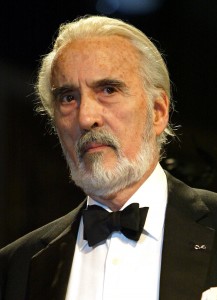
Christopher Lee is late. Not as in “the late Christopher Lee”, thankfully, not yet, though when you break a vertebra and undergo back surgery at 87 that’s always a worrying possibility. But still, half an hour late. Minders are on edge. Calls are made.
And finally here he is, unfolding his 6ft 5in frame from a black Merc with more than the usual difficulty. He walks haltingly, leaning on his cane. But with his raffish hat, white hair and patrician bearing, you would see that this was a man of distinction even if you didn’t recognise him from his films. Still, why wouldn’t you? He holds the record for the most screen credits, 250-plus, from Dracula and Sherlock Holmes through to a remarkable late flowering in Star Wars and The Lord of the Rings.
“So sorry I’m late,” he intones in the warm bass that nearly made him a professional opera singer. “It’s the Queen, you know.” The Queen’s Speech. Many London streets have closed. Having been knighted only two weeks ago, Sir Christopher can hardly complain.
We edge towards the National Portrait Gallery, where Lee later has a lunch date. He refuses painkillers because, he says, catch 22, they affect your balance. How did he bend down to be knighted if his back is so bad? “I couldn’t!” he reveals. “And also they have this platform for you to stand on, no bigger than a square tile. Well I had to tell Prince Charles’s equerry I didn’t think I could do it.”
At the restaurant entrance, while fumbling with his coat, he drops his stick. “The story of my life,” he deadpans. “Either my stick falls down or I do.”
An athlete who does his own stunts, Lee has often injured himself for art. He was thrown from a chariot in Quo Vadis; cracked three ribs in The Mummy when breaking down a door that had accidentally been locked for real; crashed a car after filming Battle of the V-1. He stumbled around, still in his SS uniform, terrifying the residents of Hove. He holds the record for the most screen swordfights. He raises a crooked little finger. Broken by Errol Flynn, apparently. “After lunch.” He cocks a single bushy brow. “A long lunch.”
This latest back injury was less spectacular. He tripped over two small cables while working on a new Hammer horror picture in New Mexico. The company that made Lee’s name (or was it the other way around?) has been resurrected by John De Mol, the founder of the media giant behind Big Brother. The double Oscar-winner Hilary Swank plays the lead, which gives some idea of the stakes (sorry) this time round. How does it feel to come back full circle? “It is ironic, isn’t it?” says Lee. “And I am one of only a handful of actors from that period, 50 years ago, to survive.”
Descended from an aristocratic Italian family, Lee honed his elocution, deportment, breathing and fencing at the Rank Charm School. A literate and thoughtful actor, he invests even villains with a depth and a quiet dignity in what he refers to as their “loneliness of evil”. He researches parts meticulously, fighting with directors over authenticity: his SS officers wear grey, not black; his Dracula dresses all in black as Bram Stoker intended, with no flashy red.
But it’s a fight he can never win. Recently he filmed Season of the Witch in Budapest with Nicolas Cage. “I was a cardinal who had contracted the plague,” he explains, “so you can imagine what I looked like! But I got to spend the five days filming in bed, which was very nice.” He was glad to see they had a language expert on set to advise the film-makers, until he got his instructions: his Italian cardinal was to be played with an American accent.
Lee has nothing but warmth for Cage, bearing no grudges for his misguided remake of The Wicker Man, the 1973 chiller that until The Lord of the Rings was Lee’s favourite of his long career. In fact, Lee is also making a new film with the original Wicker Man director, Robin Hardy. It’s not actually a sequel, Lee reveals, despite being called The Wicker Tree. He is also logging his fifth collaboration with Tim Burton, as the voice of the Jabberwock in Alice in Wonderland.
But the film closest to his heart is Glorious 39. Stephen Poliakoff’s latest historical thriller takes Lee back 70 years, to the start of the Second World War. It is set among the appeasers who believed that war would destroy England, and that striking a deal with Hitler was the only way to survive. Of the stellar cast, which includes Bill Nighy, Julie Christie, David Tennant and Jenny Agutter, Lee is the only one who was actually there.
“See now,” he says, “I remember so well. I was 17, working as an office boy for £1 a week, and I could see what was happening. After the Munich Agreement in ’38, lots of people breathed a sigh of relief, but I was old enough to know what was going on, I’d seen the parades. I remember telling my mother and my sister: ‘I don’t know about this wonderful news about peace in our time, I don’t believe it’.”
He enlisted two years later. By the age of 21 he was working as an intelligence officer, daily holding the life of thousands in his hands. He left this period out of his autobiography, Lord of Misrule. “Just because one was involved in certain operations,” he says, with typical self-effacement, “it looks as though you are saying ‘I did it’. But really it’s ‘we’.” Much of his service in North Africa was, in a strange kind of way, fun. He was nicknamed Duke, or Spy. Senior Air Force officers were called things such as Oswald Gayford and had huge handlebar moustaches. You could end up on planes to places “just like hitching a ride”.
But the end of the war was anything but fun. Because he was fluent in French and German (among other languages), he was attached to the Central Registry of War Criminals. Along with representatives of other nations, he became a Nazi hunter.
“We were given dossiers of what they’d done and told to find them, interrogate them as much as we could and hand them over to the appropriate authority. In view of the fact that there were Palestinians with us, which simply means Jews, because of course Israel was not its own country until 1948, you can imagine how they felt. We saw these concentration camps. Some had been cleaned up. Some had not.”
Lee looks away. He has no wish to project such visions on to the screen of memory, much less talk about them. But in an age when the BNP’s Nick Griffin, a man who once denied the Holocaust, can end up on Question Time, is it not important to bear witness?
“It’s not possible to deny it,” Lee says. “You can’t fake an entire camp with dying people. You can’t. Like when you see a film, even if it’s a good film, you can’t expect the camps to be accurate, for actors to look like they would really look, like they were dying. You can only go so far.”
The pain in his eyes is real, and you get a glimpse into what might animate the lonely tortured creatures he creates so effectively on screen. The doomy romanticism of his Dracula made it the surprise smash of 1958, the Twilight of its day. Five decades later, as the human face of evil in The Lord of the Rings, he proved himself the only actor on the planet able to out-thesp Ian McKellen.
Once, just once, he allows a flash of this fire to enter his otherwise unfailingly courteous conversation. We are discussing politics. Lee is staunchly Tory, a David Cameron fan. “It’s a question of ideas. And he has them. I like William Hague, too, he makes the best speeches.” He believes in stronger immigration controls. “This country is bursting at the seams. That’s not a racist position, simply that there are too many people in a small country, and that results in increased crime.”
But it’s on Europe that he feels strongest. “I’m not in favour, no. Each nation should have its own laws, its own government, its own culture. I don’t think you can create a vast melting pot. And for an unelected president to be able to tell everyone what to do, no matter who it is, is a complete disaster.
“To me, the worst thing about the European Parliament is the question of human rights. We should have our own bill of rights. I don’t want one man deciding whatever you can and can’t do. I mean if,” and here his eyes take on a peculiar intensity as if seriously contemplating such a course of action, “if I were to upend this table and smash your face with my stick and plead human rights — you see what I mean.”
Not entirely, but it would take a brave man to argue the point, bad back or no. Besides, Lee is late for his lunch guests. They are veterans, too, Special Forces, sitting tweed-jacketed in the panoramic Portrait Gallery restaurant, eye-to-eye with Nelson’s stone buttocks. Lee introduces himself, all smiles, his body language strangely deferential. Sixty years of achievement and awards melt away: it’s what you did in the war that counts.
Watching him, you are reminded of his story about playing Jinnah in 1998. Leaving aside ethnic origin, the founder of Pakistan looked remarkably like Lee. “But,” Lee says, “one person did complain to me: ‘Jinnah wasn’t as tall as you’. So I replied: ‘Maybe not, but he was a giant’.”
Once there were giants in British film, too. Sir Christopher Lee is one of the last of his kind. Long may he tower above us.
“We could dance a pas de deux,” purrs Kim Cattrall, and the cavernous dance studio where she is rehearsing her return to the West End stage suddenly feels warmer.
Five minutes in, and Cattrall’s already getting touchy-feely. So far, so like Samantha Jones, the middle-aged maneater she played in the taboo-busting television series Sex and the City. But there the resemblance ends. Samantha is imperious, in control, ever ready to conquer disaster simply by sticking her chin up and sailing through with dignity. The oldest of the SATC women, she has seen it all, done it all — and done them all. Her cocktail conversation would have Heidi Fleiss spluttering out her spritzer in shock.
Kim Cattrall is more vulnerable. She’s dressed down in very un-Samantha jeans and brown boots, and without make-up she looks soft, open, more beautiful than on screen. But is Cattrall never tempted to “put on” Samantha? “Oh God, no. No, no, no, not unless I’ve got lines to say and I’m on a set. I’ve never been able to do that thing of picking up men. I’ve never gone out looking for a man, or a relationship. It’s just evolved in a very natural way because it feels right.”
Cattrall, now 53, has been married three times, the last time so fulfillingly, in one respect at least, that she and her husband wrote a book together, Satisfaction: The Art of the Female Orgasm. Her most recent relationship, with a Canadian chef, lasted five years. It fell apart last year through pressure of work. “It’s very hard for someone not involved in this business to really understand what it’s about. You work 12-hour days, and something like a series literally consumes your life. I think it’s just time not there, really. But I’m still hopeful that I’ll meet someone.”
The chef was 25 when they started dating; Cattrall almost twice that. Not an issue, she says. “People find love in all shapes, sizes, ages, nationalities.” She bristles when people point out the age gap between her and her co-star in Private Lives, the Noël Coward revival that opens this month. Matthew Macfadyen is 18 years younger. “There’s nothing in the script about age. You know, it’s extraordinary: if Matthew was my age and I was his age, nobody would be asking me that question.”
She’s excited to be back on stage. Peter Hall tempted her to the West End in 2005, in the euthanasia drama Whose Life Is ItAnyway?, a role originally written for a man. Next up was a David Mamet, Cryptogram, in 2007. And now she has signed up for Richard Eyre. Nothing but the best for Cattrall.
“Theatre was my first love,” she says. “I saw Janet Suzman’s Rosalind [in As You Like It] at Stratford when I was 11, and I was enthralled, literally on the edge of my seat.”
Does she still get nervous? “Sometimes I think why do I have to do these scary things? It would be much easier just to play Sam for the rest of my life. You’ve been looking forward to working with this director and these actors and this play and then it comes and you think, ‘Oh, f***!’ ” Cattrall laughs uproariously. “Like, ‘Oh no! It’s here!’ You very much feel the blood coursing through your veins.”
She recently worked with the famously demanding film director Roman Polanski on The Ghost Writer, a contemporary thriller about a retired leader inspired by Tony Blair. “When I think of Roman,” she says, a tad tactlessly, “I think of his nose. He smells the truth. He knows when you’re honest. He is very intense, and very ‘on’ everyone, not just his actors but his crew. I remember I had to open a closet of a character you never see. And he stopped filming and rearranged everything. So when I opened the closet it wasn’t just random clothes, it was a specific kind of clothes that this character would have worn.
“Sometimes, because he’s French and Polish, the frustration to explain what he wants comes out like ‘No, no! Terrible, terrible!’ And you think, ‘I’m more than terrible.’ And then on a day he’d say ‘brilliant’ and you’d think, ‘Yes, I got it,’ and then you were shit again. It was in some ways very tense, and in some exhilarating. He made me crazy, but I learnt so much from him.”
But nothing could prepare her for the role, literally, of a lifetime: in the BBC’s family history documentary Who Do You Think YouAre? Cattrall was born in Liverpool, but her family moved to Canada when she was a baby. They were stony broke, couldn’t find work and ended up driving 3,000 miles across Canada to seek refuge with a distant relative in British Columbia. But that was nothing compared with what the programme discovered about her grandfather. He had abandoned his wife and kids when Cattrall’s mum was 8. Cattrall says she always liked to think that it was for some romantic reason, such as joining the Foreign Legion. In truth, he had started a bigamous second family just 30 miles to the north, eventually moving to Australia, leaving his first family bereft, penniless and without a word.
“It turned out he was just a f***ing . . . ,” she says. “The Australian family didn’t know either, they were equally devastated. Apparently he had a tattoo on his chest of my grandmother’s name. He just said it was an old flame. But that connection has now been made, and my mum and her two sisters speak to the other siblings once a week, and one of them is going out there to visit.”
Anyone who asks about SATC2 gets the same response: zip. Amid all the rumours, it can be confidently said that there will be a big gay wedding featuring the long-term character Stanford Blatch, at which Liza Minnelli will sing All the Single Ladies; that the women get to dress up as their 1980s selves in a flashback scene — Cattrall in leopard-print skin-tight trousers and huge hair; and that the ruthlessly perky teen juggernaut Miley Cyrus has a cameo alongside Cattrall, wearing exactly the same outfit at a premiere.
Cattrall, of course, could not possibly comment. Confidentiality agreements signed in triplicate, a major diplomatic event when a script that Cattrall was holding got papped with a long lens, blown up and put on the internet. “I thought, you have got to be kidding! This isn’t state secrets, it’s the f***ing script for a movie!”
Rumours of rifts with the other cast members are also swiftly dispatched. “It’s the old catfight story they’ve been wanting for years.” After working 12 hours a day together, Cattrall says, it’s not surprising if you don’t then hang out as well. But there has been some unease between her and Sarah Jessica-Parker, who crucially is the co-producer of the show and not just the star, ever since Cattrall turned down the first SATC film for four years until she (and the other girls) were given a better script and more money.
And rightly so, in retrospect. The film took more than $400 million and, together with Mamma Mia!, proved to Hollywood that there was a market for films starring women over 40.
And what next? She has nothing planned as yet, but it’s bound to be surprising. Cattrall began her chequered film career in the teen comedy Porky’s, as a cheerleader who climaxes like a she-wolf crossed with a police siren. Cattrall sustains the operatic orgasm for fully one minute and ten seconds of screen time — take that, Meg Ryan. And in the previous SATC movie she had to lie for hours naked except for strategically placed sushi.
“Someone asked me what I do better than anyone else, and I said that I think I do ‘sexy clown’ quite well. I’m not frightened of pie in the face, I think that’s glorious. I don’t take myself seriously at all.”
Perfect for her part in Private Lives — not to mention her life in private parts.
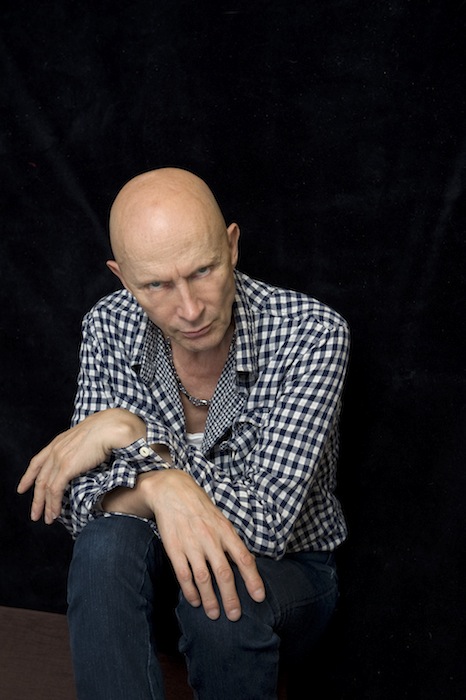
Richard O’Brien dabs at his eyes with a white linen napkin. Somehow the waitress chooses this moment to take our order, and is waved away. We’ve met to discuss O’Brien’s new project, The Stripper, a revival of his 1982 musical, which previously has played only in Australia. Instead, just 20 minutes in, the writer and star of The Rocky Horror Show and host of The Crystal Maze is choked with emotion.
“Not so long ago,” he confides, “I fell off the wagon, stepped into the abyss.” He is small but elegant, like a cashmere jumper washed on too high a heat. His porcelain features, sardonic smile and shaved head strip two decades from his 67 years. And what does he mean exactly, “stepped into the abyss”? “Oh,” O’Brien replies, with a studied attempt at nonchalance, “I went completely crackers.
“All my life,” he explains with mounting emotion, “I’ve been fighting never belonging, never being male or female, and it got to the stage where I couldn’t deal with it any longer. To feel you don’t belong . . . to feel insane . . . to feel perverted and disgusting . . . you go f***ing nuts. If society allowed you to grow up feeling it was normal to be what you are, there wouldn’t be a problem. I don’t think the term ‘transvestite’ or ‘transsexual’ would exist: you’d just be another human being.”
Perhaps this shouldn’t come as such a surprise from the man who wrote the song I’m just a Sweet Transvestite from Transsexual Transylvania, and dressed his entire cast in basques, high heels and fishnet stockings. Yet apart from some elliptical programme notes about being “confined to a life in no man’s land”, O’Brien has never spoken in public of his sexuality. And to find a man of his age and success so confused . . . what happened?
“I’d been fighting, going to therapy, treating what I was as though it were some kind of illness to be cured. But actually, no, I was basically transgender, and just unhappy.” He’s centred enough now to explain the difference calmly: he’s not transsexual, which would mean he felt like a woman, to the extent of wanting an operation to turn him into one; but transgender, which means feeling like neither quite man nor woman. “There is a continuum between male and female,” he says. “Some are hard-wired one way or another, I’m in between. Or a third sex, I could see myself as quite easily.” But at the time, he was not so phlegmatic. “I lost the plot. Paranoid delusions, the works. It was at the time when Bush and Blair ruled the f***ing world, and trying to claw my way back to sanity, I saw no standard norm. I wanted to get back to normal, but where’s the benchmark of sanity? I was drowning and couldn’t find a surface. And then I was talking to my son in Canada, and he told me how much he loved me, how he absolutely . . .”
O’Brien shakes his head in wonder. “It was my children’s love that gave me a centre again. They gave me acceptance of myself, and allowed me to be myself.”
Surely his kids had already guessed that he wasn’t, shall we say, a traditional dad? Even on The Crystal Maze, the Nineties game show that was often Channel 4’s highest rated programme, O’Brien would leap about in skin-tight leather trousers and furry jacket, and speak archly of a backroom figure called “Mumsie”.
“Ha! You’re right!” O’Brien hoots. When he finally plucked up the courage to tell his children he was transgender, their first reaction was: “Dad, and your point is?”
When The Rocky Horror Show opened at the Royal Court Upstairs in 1973, it was joyous, liberating, shocking. A rock’n’roll musical about two clean-cut college sweethearts who spend a life-changing night in a castle with Dr Frank N. Furter and his eccentric retinue, it can be read as an allegory of a drug trip, a paean to (or warning about) sexual experimentation, a love letter to old B-movies, even as a satire on the political degeneracy of America: the 1975 film version, which has repaid its $1 million budget more than a hundredfold, is pointedly set on the night of Nixon’s resignation.
More simply, it’s a contemporary panto that for 35 years has given the audience an excuse to drag up, shout out the best lines, and pelt the screen with bread when Frank calls for “a toast!”. And it’s Frank — dangerously charismatic, thoroughly amoral and joyously polysexual, gloriously played by Tim Curry in the film version and by David Bedella in the forthcoming stage tour — who gives the show its beating heart.
And here a truly surprising thing happens. “He’s a drama queen, really,” O’Brien says of Frank. “He’s a hedonistic, self-indulgent voluptuary, and that’s his downfall. He’s an ego-driven . . . um . . .” and here his voice lowers to a stage whisper, “I was going to say, a bit like my mother.” What was that? Is O’Brien really revealing after all these years that the inspiration for Dr. Frank N. Furter is his mother? This psycho scientist in fishnets who creates a muscle-bound zombie to be his sex toy? Who beds first the innocent Janet and then her straight-as-a-die fiancé Brad? Who seemingly cares for no one and nothing beyond his own gratification? O’Brien’s mum?
“My mother was an unpleasant woman,” O’Brien says with sudden venom. “She came from a working-class family: wonderful people, not much money, undereducated but honest, a great moral centre of honesty and probity. And she disowned them. She wanted to be a lady. And consequently became a person who was racist, anti-Semitic . . . It’s such a tragedy to see someone throwing their lives away on this empty journey, and at the same time believing herself superior to other people.
“I loved her, but stupid, stupid woman, she wouldn’t understand the value of that. She was an emotional bully. And sadly all of us, my siblings and I, are all damaged by this. She was bonkers, my mother, and I think by saying that I’m allowing her to be as horrible as she was without condemning her too much.”
This, it transpires, is the real reason O’Brien’s parents uprooted the family from Gloucestershire when he was 10 to a 120acre farm in New Zealand: so that Mumsie could reinvent herself as posh. Small and effeminate, the young O’Brien was no one’s ideal of Antipodean manhood, and he was routinely caned by teachers. He left school at 15. After five years training as a barber, of all things, he hopped on a boat to London just in time for the Sixties to swing. His breakthrough, ironically, was touring with Hair. The director Jim Sharman then cast him in Jesus Christ Superstar, after which they worked together on a musical O’Brien was calling They Came from Denton High. Sharman suggested the title The Rocky Horror Show, and the rest is hysteria.
If O’Brien ever doubts his legacy he need only remember this: in his home town of Hamilton, New Zealand, there now stands, bigger than life, a bronze statue of himself in his Rocky Horror guise.
And now comes The Stripper, a tale of “blondes, burlesque and bullets” that he adapted from a pulp novel by Carter Brown who, O’Brien says, “never introduced a girl unless he introduced her breasts at the same time”. O’Brien himself will play a cameo. And there’s yet another touring production of The Rocky Horror Show.
O’Brien gets all the devilish parts: the Child Catcher in the recent Chitty Chitty Bang Bang stage show; a one-man cabaret show as Mephistopheles; a corrupt druid in Robin of Sherwood on ITV; an alien in Dark City. You believe him when he says: “I’ve got a really bad temper. I get a few dinosaurs in the street, calling out comments when I’m all dressed up, and I’m like,‘You’re f***ing with the wrong drag addict’.”
Yet he’s a pussycat, really. He’s not currently in a relationship, and says he adores “pottering about” on his own: “You should never go looking for love. One day it will hit you smack in the face.” He’s been married twice, happily, and says of sexual attraction that he doesn’t see the gender, he sees the person.
He’s forgotten, but I first interviewed him more than 20 years ago. He flirted outrageously. “DidI?” he asks, in mock surprise. And as we part this time, no firm handshakes: instead he reaches up and softly strokes my cheek. And then he’s off, through the streets of Soho. In skinny white Armani jeans, a jacket with the shoulders cut off, chunky crosses, and a woman’s wraparound cardigan, he may be still somewhere between male and female, still in that sexual no man’s land. But at long last he’s called a ceasefire.